
Training / Event Calendar
Grief Support Group for Professionals
This virtual group meets on the 3rd Monday of each month at 6 PM MT Schedule Appointment with HeartLight Center and is designed to address the grief experienced when confronted with multiple, ongoing losses in the workplace. It is appropriate for professionals such as hospice caregivers, funeral professionals, healthcare workers, law enforcement officials, chaplains, social workers, and first responders. The group will address work-related grief that often goes ignored and unacknowledged; when left unaddressed, this grief can lead to burnout, post-traumatic stress, compassion fatigue, and loss of hope.
First Responder Community Support Group for Survivors of Suicide
Virtual - 2nd Tuesday of each month
Grief Support Group for Professionals
This virtual group meets on the 3rd Monday of each month at 6 PM MT Schedule Appointment with HeartLight Center and is designed to address the grief experienced when confronted with multiple, ongoing losses in the workplace. It is appropriate for professionals such as hospice caregivers, funeral professionals, healthcare workers, law enforcement officials, chaplains, social workers, and first responders. The group will address work-related grief that often goes ignored and unacknowledged; when left unaddressed, this grief can lead to burnout, post-traumatic stress, compassion fatigue, and loss of hope.
Chaplain Essential & Advanced Training (AZ)
Essentials & Advanced Chaplain Training for Emergency Responder Chaplains
Dates:
Tuesday, November 17 through November 19, 9am - 5pm
Location:
Town of Queen Creek Public Safety Support Facility
22050 E Queen Creek Rd
Queen Creek, AZ 85142
Cost: $150
Courses:
BCT 1 Introduction to Responder Chaplaincy
BCT 2 The LE and Fire Rescue Family
BCT 3 Introduction to Stress Management
BCT 4 Ministry of Presence
BCT 5 Family Support for Responders
BCT 6 Constitutional Law
BCT 7 Foundations of Chaplaincy
BCT 8 Ethics of a Chaplain
BCT 9 Moral Injury
BCT 10 Intro to Suicide Prevention
BCT 11 Line of Duty Death and Injury
ACT 406 Chaplain Safety, De-escalation
ACT 407 Autism and Special Needs Engagement
ACT 502 Critical Incident Debriefs
ACT 504 Emotional Resilience and Spiritual Care
ACT 508 Death Notification & Funeral Planning
Find out more about Serving The Shield at servingtheshield.com.
If you have any questions please contact:
Travis Akins at Travis@servingtheshield.com / 303-243-4878
Detective Scott Krassow at Scott.Krassow@mesaaz.gov
Chaplain Advanced One-Day Training (AZ)
Essentials & Advanced Chaplain Training for Emergency Responder Chaplains
Dates:
Thursday, November 19, 9am - 5pm
Location:
Town of Queen Creek Public Safety Support Facility
22050 E Queen Creek Rd
Queen Creek, AZ 85142
Cost: $50
Courses:
ACT 406 Chaplain Safety, De-escalation
ACT 407 Autism and Special Needs Engagement
ACT 502 Critical Incident Debriefs
ACT 508 Death Notification & Funeral Planning
Find out more about Serving the Shield at servingtheshield.com.
If you have any questions please contact:
Travis Akins at Travis@servingtheshield.com / 303-243-4878
Detective Scott Krassow at Scott.Krassow@mesaaz.gov
First Responder Community Support Group for Survivors of Suicide
Virtual - 2nd Tuesday of each month
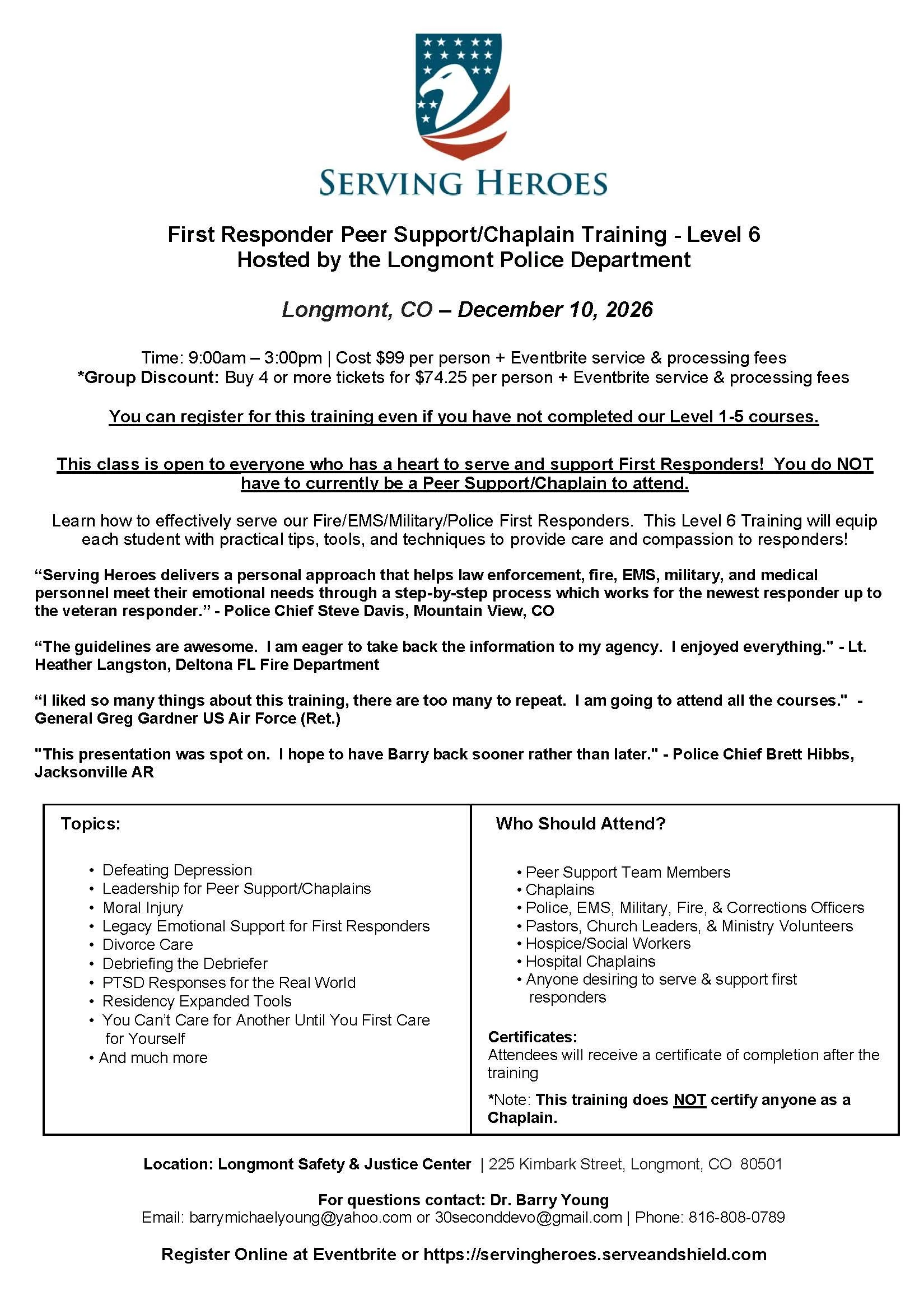
Serving Heroes Level 6 - CO
Overview
This class is not only open to Peer Support/Chaplains but ANYONE who has a heart to serve and support First Responders.
First Responder Peer Support/Chaplain Training - Level 6
Hosted by the Longmont Police Department
Longmont, CO - December 10, 2026
Time: 9:00am – 3:00pm
Cost Serving the Shield Members: $80
Cost non-members: $99 per person + Eventbrite service & processing fees
*Group Discount: Buy 4 or more tickets for $74.25 per person + Eventbrite service & processing fees
You can register for this class even if you have not completed our Level 1-5 trainings.
Topics:
Defeating Depression
Leadership for Peer Support/Chaplains
Moral Injury
Legacy Emotional Support for First Responders
Divorce Care
Debriefing the Debriefer
PTSD Responses for the Real World
Residency Expanded Tools
You Can’t Care for Another Until You First Care for Yourself
And much more
Who Should Attend?
Peer Support Team Members
Chaplains
Police, EMS, Military, Fire, & Corrections Officers
Pastors, Church Leaders, & Ministry Volunteers
Hospice/Social Workers
Hospital Chaplains
Anyone desiring to serve & support First Responders
Certificates:
Attendees will receive a certificate of completion after the training.
Location: Longmont Safety & Justice Center|225 Kimbark Street, Longmont, CO 80501
For questions contact: Dr. Barry Young
Email: barrymichaelyoung@yahoo.com or 30seconddevo@gmail.com | Phone: 816-808-0789
Grief Support Group for Professionals
This virtual group meets on the 3rd Monday of each month at 6 PM MT Schedule Appointment with HeartLight Center and is designed to address the grief experienced when confronted with multiple, ongoing losses in the workplace. It is appropriate for professionals such as hospice caregivers, funeral professionals, healthcare workers, law enforcement officials, chaplains, social workers, and first responders. The group will address work-related grief that often goes ignored and unacknowledged; when left unaddressed, this grief can lead to burnout, post-traumatic stress, compassion fatigue, and loss of hope.
Serving the Shield Annual Conference
2027 Serving The Shield Annual Conference
Date | Time:
April 21, 2027 from 9:00am to 5:00pm.
Location:
TBD
Save the Date - Details Coming Soon.
Marriage Retreat - Responding To Relationships
We’re thrilled to share some exciting news—Responding to Relationships (RTR) is back! Our next retreat will take place October 16–18 at the The Inverness Denver Hotel.
Because space is limited to 40 military/first responder couples, this form gives you the opportunity to be notified as soon as registration goes live. Please note that completing this form does not reserve your spot or guarantee registration.
This retreat is open to couples who have not previously attended a Responding to Relationships retreat. Once registration opens, eligible couples will be able to register on a first-come, first-served basis.
By completing this form, you are requesting to receive a notification when registration becomes available.
First Responder Community Support Group for Survivors of Suicide
Virtual - 2nd Tuesday of each month
RMPFC Essentials Chaplain Training
Rocky Mountain Police & Fire Essentials Chaplain Training
Dates | Time:
Friday, October 9 1pm-8pm
Saturday, October 10 9am-5pm
Cost: $100
Chaplain Training Standards
BCT 01 Introduction to Law Enforcement & Fire Chaplaincy
BCT 02 The Law Enforcement & Fire Family
BCT 03 Stress Management
BCT 04 Ceremonies and Events
BCT 05 Responder Family Support
BCT 06 Constitutional Law/Confidentiality
BCT 07 Foundations in Chaplaincy
BCT 08 Ethics of a Chaplain
BCT 09 Moral Injury
BCT 10 Suicide Prevention
BCT 11 Line of Duty Death and Injury
Engage-Calm-Distract Training
Understanding and responding to children in distress
Supporting children in distress can pose particular challenges for providers, families, and first responders, whether delivering emergency medical services, responding to a disaster, or providing daily care. Children have unique physical, developmental, medical, and behavioral health needs that may be difficult to address. These challenges can bring up emotions in individuals who are supporting children, which may interfere with their information processing and decision-making abilities. Providers have reported that their own emotional responses, lack of experience working with kids, and the emotions of family members can all negatively impact the quality of care they are able to provide while working with children in distress.
The resource kit includes the Engage-Calm-Distract responder manual and the Pediatric Emotional Distress Reference System (PEDRS) quick reference guide.
Engage-Calm-Distract
The Engage-Calm-Distract (ECD) manual provides foundational material on what to expect when children are in distress and information about developmentally appropriate strategies for engaging, calming, and distracting children and their caregivers during times of crisis. The ECD manual also includes information on how those who respond to a crisis or disaster can take care of themselves, use a trauma-informed approach, and understand their own capacity for what might cause a higher level of discomfort. The most recent version now includes information on access and functional needs and ways to support those with intellectual and developmental disabilities.
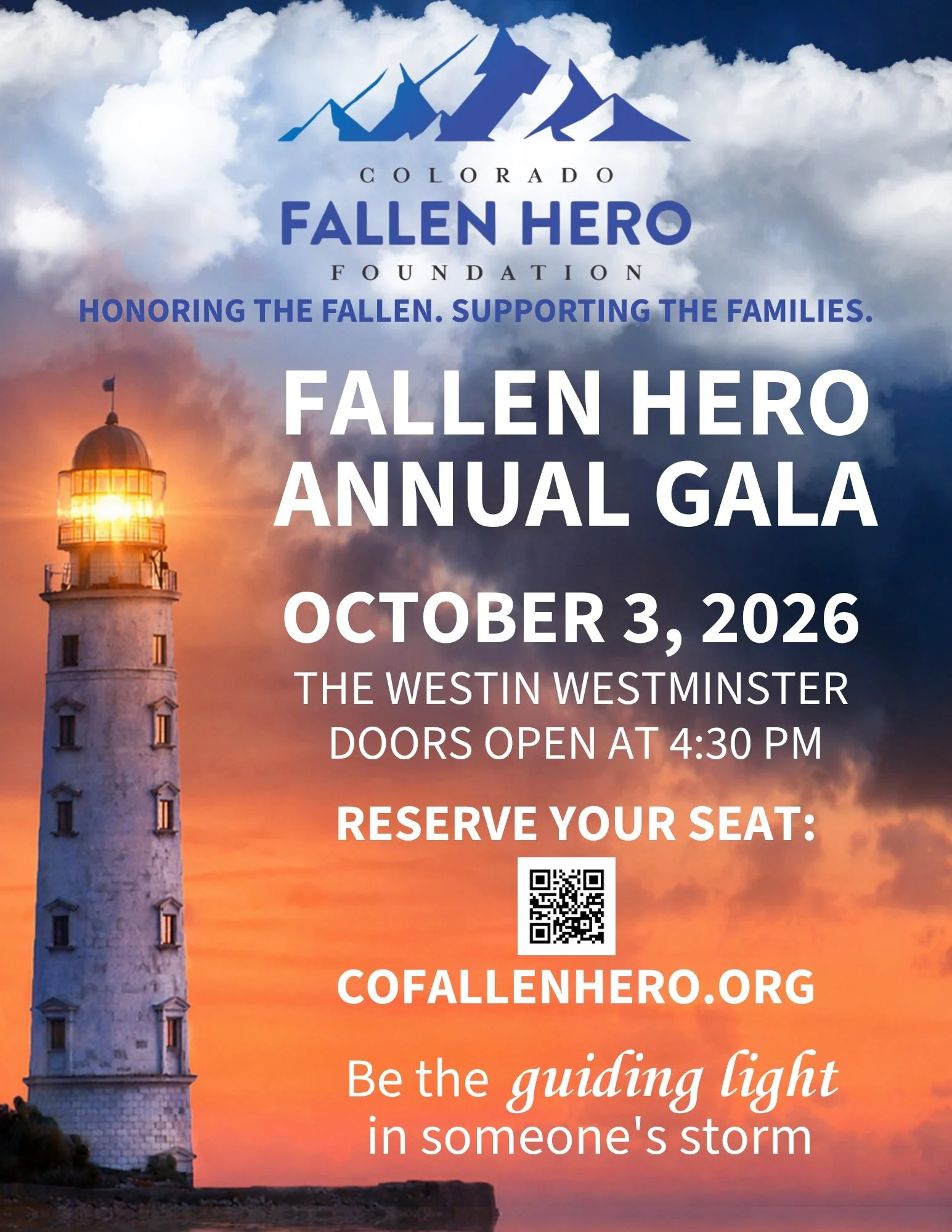
2026 Fallen Hero Annual Gala
Join us for an unforgettable evening at the 2026 Gala, hosted by The Colorado Fallen Hero Foundation on October 3, 2026, from 4:30 PM to 11:30 PM at The Westin Westminster. This elegant and inspiring event will bring together community members, supporters, and friends from across Colorado to honor the brave men and women who made the ultimate sacrifice in service to others.
The evening will begin with a lively cocktail reception where guests can connect, browse the silent auction, and enjoy a variety of unique experiences throughout the ballroom. During the reception, guests will have the opportunity to purchase a custom-fit Colorado Fallen Hero Foundation branded cowboy hat, visit our interactive photo booths, relax in the cigar lounge, and enjoy a curated whiskey tasting experience.
Following the reception, guests will move into the ballroom for a plated dinner, powerful speakers sharing stories of sacrifice, resilience, and the impact of the Foundation’s work, as well as an exciting live auction featuring exclusive items and experiences. Throughout the evening, we will celebrate the heroes we honor and the families we support.
After dinner, the energy continues with entertainment by Colorado Keys Dueling Pianos. Guest song requests will be welcomed, dancing is encouraged, and the celebration will continue in a way that is sure to make the night one to remember.
Your participation will not only create meaningful memories, but will also directly support the Foundation’s mission of serving the families of Colorado’s fallen heroes.
Mark your calendars for a night of gratitude, generosity, connection, and celebration. We look forward to welcoming you.
Grief Support Group for Professionals
This virtual group meets on the 3rd Monday of each month at 6 PM MT Schedule Appointment with HeartLight Center and is designed to address the grief experienced when confronted with multiple, ongoing losses in the workplace. It is appropriate for professionals such as hospice caregivers, funeral professionals, healthcare workers, law enforcement officials, chaplains, social workers, and first responders. The group will address work-related grief that often goes ignored and unacknowledged; when left unaddressed, this grief can lead to burnout, post-traumatic stress, compassion fatigue, and loss of hope.
Essentials Chaplain Training - WY - Advanced One Day
This event has been postponed until Spring 2027.
Essentials Chaplain Training for Emergency Responder Chaplains - Advanced One Day
Dates:
Saturday, September 19, 9am – 5pm
Location:
College Heights Baptist Church
1927 S Walnut St
Casper, Wy 85205
Cost:
$65, includes two year AHA CPR Certification
Lunch will be provided.
Courses:
ACT 401 1st Aid, CPR, AED, and Stop the Bleed
ACT 502 Debriefing a Critical Incident
ACT 504 Emotional Resilience and Spiritual Care
Essentials Chaplain Training - WY
This event has been postponed until Spring 2027.
Essentials Chaplain Training for Emergency Responder Chaplains
Dates:
Friday, September 18 9am - 5pm
and
Saturday, September 19, 9am – 5pm
Location:
College Heights Baptist Church
1927 S Walnut St
Casper, Wy 85205
Cost: $75
Lunch will be provided.
Courses:
BCT 101 Introduction to Law Enforcement & Fire Rescue Chaplaincy
BCT 102 The Law Enforcement and Fire Rescue Family
BCT 103 Introduction to Stress Management
BCT 104 Ministry of Presence
BCT 105 Family Support for Responders
BCT 106 Constitutional Law
BCT 107 Foundations of Chaplaincy
BCT 108 Ethics of a Chaplain
BCT 109 Moral Injury
BCT 110 Intro to Suicide Prevention
BCT 111 Line of Duty Death and Injury
ACT 504 Emotional Resilience and Spiritual Care
First Responder Community Support Group for Survivors of Suicide
Virtual - 2nd Tuesday of each month
First Responder Community Support Group for Survivors of Suicide
Virtual - 2nd Tuesday of each month
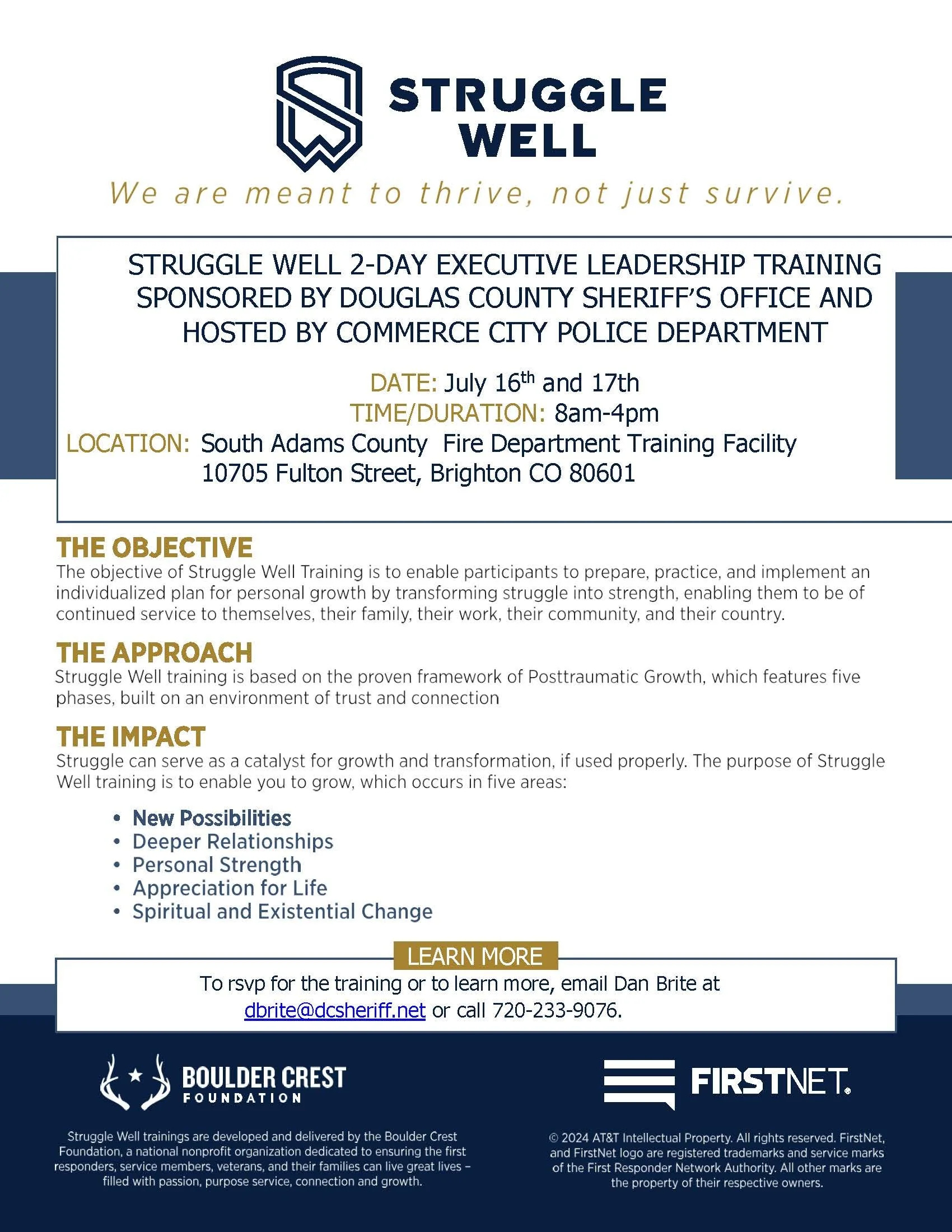
Struggle Well for Executive Leadership
To RSVP for the training or to learn more, email Dan Brite at dbrite@dcsheriff.net or call at 720-233-9076.
SAFLEO Train-the-Trainer Virtual Workshop
SAFLEO Train-the-Trainer Virtual Workshop
Live Session Date/Time: Thursday, July 16, 2026, from 10:00 a.m. to 12:00 p.m., Eastern Time
Credit Hours: 8 hours
You can register for this event directly at: https://www.safleo.org/Training/Event/July-16-2026
First Responder Community Support Group for Survivors of Suicide
Virtual - 2nd Tuesday of each month
SAFLEO Line Officer Virtual Training
SAFLEO Line Officer Virtual Training
Thursday, July 2, 2026
Training will be held from 10:00 a.m. to 3:00 p.m., Eastern Time
Lunch break will be held from 12:00 p.m. to 1:00 p.m., Eastern Time
Credit Hours: 4 hours
You can register for this event directly at: https://www.safleo.org/Training/Event/July-2-2026
SAFLEO Leadership and Supervision Virtual Training
SAFLEO Leadership and Supervision Virtual Training
Tuesday, June 30, 2026
Training will be held from 10:00 a.m. to 3:00 p.m., Eastern Time
Lunch break will be held from 12:00 p.m. to 1:00 p.m., Eastern Time
Credit Hours: 4 hours
You can register for this event directly at: https://www.safleo.org/Training/Event/June-30-2026
SAFLEO Line Officer Virtual Training
SAFLEO Line Officer Virtual Training
Thursday, June 25, 2026
Training will be held from 10:00 a.m. to 3:00 p.m., Eastern Time
Lunch break will be held from 12:00 p.m. to 1:00 p.m., Eastern Time
Credit Hours: 4 hours
You can register for this event directly at: https://www.safleo.org/Training/Event/June-25-2026
SAFLEO Leadership and Supervision Virtual Training
SAFLEO Leadership and Supervision Virtual Training
Thursday, June 18, 2026
Training will be held from 8:00 a.m. to 1:00 p.m., Mountain Time
Lunch break will be held from 10:00 p.m. to 12:00 p.m., Mountain Time
Credit Hours: 4 hours
You can register for this event directly at: https://www.safleo.org/Training/Event/June-18-2026
Peer Support Retreat
Retreats, Trainings, & Resilience
Tools That Work
Peer Support Retreat June 17 - 19
For years, agencies have requested a peer support retreat. A retreat built for individual peer supporters, not the entire team. Too many agencies can't afford to send the entire team at once.
June is our answer to that.
Held at our Eagle Creek Retreat Center in the mountains above Idyllwild, California, this 3-day, 2-night retreat is designed specifically for peer supporters who routinely help others through critical incidents, cumulative trauma, and occupational stress.
Alongside peer supporters from other agencies, attendees will step out of their support role and into their own restoration. The retreat covers the emotional demands of the peer support role, signs of compassion fatigue and secondary traumatic stress, practical self-regulation and resilience skills, and the line between helping, over-functioning, and rescuing. Every attendee leaves with a personalized resilience and self-care plan and a realistic post-retreat aftercare plan to back it up.
Retreat Details
Arrive Wednesday, June 17 between 11:00 - 11:30 AM (PT)
Depart Friday, June 19 at approximately 11:00 AM (PT)
Cost: $2,000 per person
Registration required. Space is limited
This is a first-of-its-kind offering from Shift Wellness, and seats will fill fast. If you have peer supporters who give everything to others, this retreat gives something back.
First Responder Community Support Group for Survivors of Suicide
Virtual - 2nd Tuesday of each month
Intensity vs. Connection: The Core Conflict Driving Chemsex
This training explores the central role of intensity-driven learning in chemsex and how it reshapes desire, behavior, and recovery trajectories. Moving beyond traditional addiction frameworks, participants will examine how substances paired with sexual experience create powerful, rapidly encoded arousal patterns that prioritize intensity over connection and meaning. The presentation introduces a clinically grounded model of the “intensity gap” to explain common recovery challenges such as anhedonia, euphoric recall, and difficulty re-engaging in relational intimacy. Attendees will leave with practical, immediately applicable tools to help clients retrain arousal, rebuild meaning-based connection, and navigate recovery without relying on high-intensity reinforcement.
By the end of this course, participants will be able to:
Explain how chemsex functions as an accelerated form of erotic learning driven by intensity and dopamine-based conditioning.
Identify key clinical phenomena associated with the “intensity gap,” including anhedonia, euphoric recall, and disrupted intimacy.
Apply practical interventions (e.g., intensity mapping, “finish the story,” and meaning-based arousal strategies) to support sustainable recovery and sexual reintegration.
There are 2.0 continuing education credits available for this course.
The Weight of Service: Trauma, Moral Injury, and the Unbroken Program for First Responders (Copy) (Copy)
Description
First responders, veterans, and active-duty service members experience elevated levels of trauma exposure, placing them at increased risk for a range of mental health concerns. Post-traumatic stress disorder (PTSD) and moral injury frequently present with overlapping yet distinct clinical features and are often accompanied by co-occurring disorders such as substance use, depression, and anxiety. Evolving treatment approaches emphasize trauma-focused care, enhanced engagement strategies, and culturally responsive interventions tailored to the unique experiences of these populations. Specialized programming, such as The Meadows’ Unbroken program, reflects an ongoing commitment to addressing the complex clinical needs of those who serve on the front lines.
Educational Goal
The educational goal of this workshop is to enhance clinicians’ understanding of trauma-related mental health concerns in first responders, veterans, and active-duty personnel. Emphasis is placed on differentiation between PTSD and moral injury, recognition of common comorbidities, and application of trauma-focused approaches to improve engagement and treatment outcomes.
Learning Objectives
Participants will be able to:
Identify key mental health risks and stressors affecting first responders, veterans, and active-duty personnel.
Differentiate between post-traumatic stress disorder (PTSD) and moral injury, including their distinct clinical presentations and implications for treatment.
Recognize common comorbid conditions, including substance use disorders, depression, and anxiety.
Apply trauma-focused approaches to enhance client engagement and improve treatment outcomes.
The Weight of Service: Trauma, Moral Injury, and the Unbroken Program for First Responders (Copy)
Description
First responders, veterans, and active-duty service members experience elevated levels of trauma exposure, placing them at increased risk for a range of mental health concerns. Post-traumatic stress disorder (PTSD) and moral injury frequently present with overlapping yet distinct clinical features and are often accompanied by co-occurring disorders such as substance use, depression, and anxiety. Evolving treatment approaches emphasize trauma-focused care, enhanced engagement strategies, and culturally responsive interventions tailored to the unique experiences of these populations. Specialized programming, such as The Meadows’ Unbroken program, reflects an ongoing commitment to addressing the complex clinical needs of those who serve on the front lines.
Educational Goal
The educational goal of this workshop is to enhance clinicians’ understanding of trauma-related mental health concerns in first responders, veterans, and active-duty personnel. Emphasis is placed on differentiation between PTSD and moral injury, recognition of common comorbidities, and application of trauma-focused approaches to improve engagement and treatment outcomes.
Learning Objectives
Participants will be able to:
Identify key mental health risks and stressors affecting first responders, veterans, and active-duty personnel.
Differentiate between post-traumatic stress disorder (PTSD) and moral injury, including their distinct clinical presentations and implications for treatment.
Recognize common comorbid conditions, including substance use disorders, depression, and anxiety.
Apply trauma-focused approaches to enhance client engagement and improve treatment outcomes.